Start with the affected area and the surrounding roof
A useful repair assessment establishes what failed, how far the problem extends, and whether the surrounding materials can support a suitable repair. Share what you have noticed and any earlier work. Ask for the recommendation to explain the findings and any limitations before you choose the scope.
Describe active water entry when requesting urgent help
When water is entering, explain the current situation when you call: the property address, where the water appears, when it started, and whether it is increasing. Ask about the next available assessment and whether temporary protection can be considered for the conditions at your property.
Temporary protection and a permanent repair have different purposes. Ask what any temporary work covers, what remains to be investigated, and how follow-up will be arranged. Access and weather can affect the response. Share observations from a safe location and leave roof access to the roofing team.
Include flashing and roof junctions in the repair scope
A roof is interrupted by features such as walls, chimneys, pipes, skylights, and intersecting slopes. Where those features are present in the affected area, their connections need consideration alongside the covering. Flashing work should be described clearly enough that you can tell which junction is included.
If the proposed solution mentions sealant, ask what underlying condition it addresses and whether any damaged flashing or adjoining material also needs work. Different roof details need different treatment. The recommendation should follow what is found on your property rather than assume every leak has the same cause.
Check the surrounding roof before replacing damaged shingles
A limited area of shingle damage may be repairable when the surrounding roof remains serviceable and suitable materials can be used. The assessment needs to distinguish an isolated defect from deterioration extending across a larger slope. The roof age is useful background, but its actual condition matters to the decision.
Discuss the affected area, the condition of adjoining shingles, and how the repair will meet the remaining roof. Replacement shingles may differ in appearance from weathered materials. A proposal should explain any material or access limitations before you agree to the work.
Compare repair estimates by their work limits
The visible size of a stain is not a reliable measure of the work above it. An estimate should identify the affected area, the proposed repair, and how concealed damage will be handled. Compare these points rather than assuming two totals cover the same work:
- The roof material and the area included in the repair.
- Relevant flashing, penetrations, edges, and roof transitions.
- Access, height, pitch, and material-handling arrangements.
- Known damage beneath the covering and any allowance for concealed conditions.
- How additional work will be documented, priced, and approved.
- Exclusions, completion review, and any written warranty terms offered.
Local property details and construction questions
For New Brunswick enquiries, provide the full street address and Middlesex County location when arranging the assessment. This helps connect the visit, access arrangements, and any local construction questions with the correct property.
For scope-specific construction questions, start with NJ.gov locality search. Confirm which requirements apply to the actual property and proposed work, and agree who will handle any required applications or inspections. A roof repair or replacement description for another property does not establish the requirements for yours.
Documented roofing work in Middlesex County
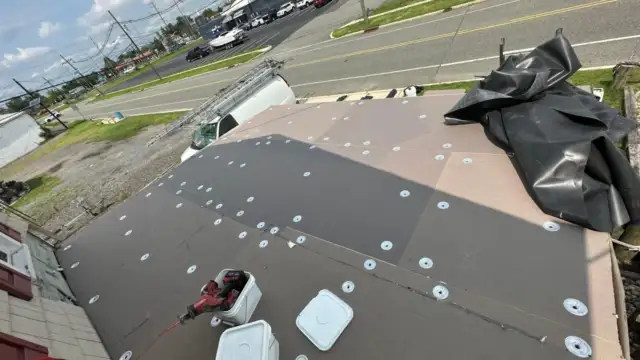
The documented South Amboy replacement included new plywood decking, GAF Camelot architectural shingles, membrane waterproofing on a low-slope section, rebuilt valleys, and renewed chimney and roof-transition flashing. Large sections were opened to the framing before the new plywood was installed. View the South Amboy roofing project and photographs.
It illustrates why decking and connections between different roof sections belong in the scope alongside the visible shingles.
These examples document replacement work. They do not mean that your roof needs replacement. Use the assessment to establish whether a limited repair is suitable for the condition found.
When to compare a repair with replacement
A localized defect may be repairable when the surrounding roof remains serviceable. Wider deterioration, recurring problems, or damage beneath the covering can change the recommendation. Ask why the proposed work fits the condition found and what a smaller repair would leave unresolved.
See the separate roof replacement in New Brunswick for that option. For the broader local service overview, visit New Brunswick roofing service areas.
Request a roof repair estimate in New Brunswick
Call (973) 510-1541 or request an estimate from Done Rite Roof Repair – Exteriors. Share the property address, known roof concerns, earlier work, and access restrictions. Photos taken safely from inside or at ground level can help explain the issue. The company office is at 299 Columbia Ave, Jersey City, NJ 07307, United States.