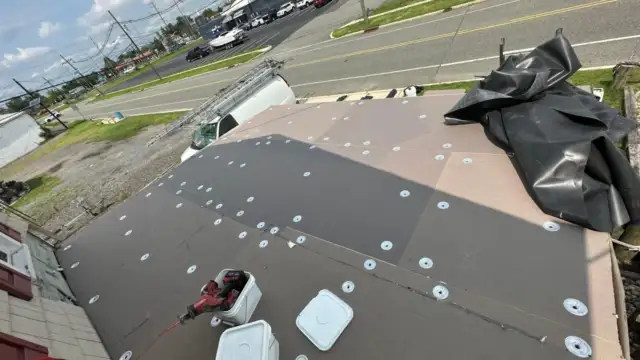
Start with the affected area and the surrounding roof
A useful repair assessment establishes what failed, how far the problem extends, and whether the surrounding materials can support a suitable repair. Share what you have noticed and any earlier work. Ask for the recommendation to explain the findings and any limitations before you choose the scope.
Include flashing and roof junctions in the repair scope
A roof is interrupted by features such as walls, chimneys, pipes, skylights, and intersecting slopes. Where those features are present in the affected area, their connections need consideration alongside the covering. Flashing work should be described clearly enough that you can tell which junction is included.
If the proposed solution mentions sealant, ask what underlying condition it addresses and whether any damaged flashing or adjoining material also needs work. Different roof details need different treatment. The recommendation should follow what is found on your property rather than assume every leak has the same cause.
Review the company details and written terms
Before agreeing to roof work, check that the written proposal identifies the business, property, scope, and contact details correctly. Request current evidence for any registration, insurance, or manufacturer credential being claimed. Review any offered warranty documents for the actual repair.
Compare the work limits, exclusions, payment arrangements, and process for approving changes. If a product warranty or workmanship term is important to your decision, have it identified in writing. A general durability claim does not explain the conditions that apply to your agreement.
Trace the leak before choosing the repair
Water appearing at a ceiling or wall is a symptom to investigate. It may have traveled from a different part of the roof before becoming visible indoors. Describe when the problem occurs, which rooms are affected, and whether earlier repairs changed it. The assessment should connect those observations with the roof covering and surrounding details.
Ask the proposal to identify the suspected entry point, the materials involved, and the limits of what can be confirmed without opening the roof. An unexplained patch over the visible problem may leave related damage unaddressed. Photographs and previous repair records can help explain the history.
Compare repair estimates by their work limits
The visible size of a stain is not a reliable measure of the work above it. An estimate should identify the affected area, the proposed repair, and how concealed damage will be handled. Compare these points rather than assuming two totals cover the same work:
- The roof material and the area included in the repair.
- Relevant flashing, penetrations, edges, and roof transitions.
- Access, height, pitch, and material-handling arrangements.
- Known damage beneath the covering and any allowance for concealed conditions.
- How additional work will be documented, priced, and approved.
- Exclusions, completion review, and any written warranty terms offered.
Local property details and construction questions
For Upper Saddle River enquiries, provide the full street address and Bergen County location when arranging the assessment. This helps connect the visit, access arrangements, and any local construction questions with the correct property.
For scope-specific construction questions, start with Upper Saddle River Borough construction information. Confirm which requirements apply to the actual property and proposed work, and agree who will handle any required applications or inspections. A roof repair or replacement description for another property does not establish the requirements for yours.
Documented roofing work in Bergen County
The documented Westwood winter replacement included new plywood decking, synthetic underlayment, charcoal architectural shingles, chimney flashing, and waterproofing at roof penetrations. The work was completed in stages across a steep roof with intersecting sections. View the Westwood roofing project and photographs.
The project illustrates the relationship between access, preparation, roof geometry, and the installation schedule.
The documented Wyckoff replacement covered the main house and attached garage with architectural asphalt shingles. The scope also addressed damaged decking where necessary, underlayment, waterproofing at vulnerable areas, chimney flashing, and a plumbing vent penetration. View the Wyckoff roofing project and photographs.
It shows why replacement proposals should identify the connected roof sections and their flashing details.
These examples document replacement work. They do not mean that your roof needs replacement. Use the assessment to establish whether a limited repair is suitable for the condition found.
When to compare a repair with replacement
A localized defect may be repairable when the surrounding roof remains serviceable. Wider deterioration, recurring problems, or damage beneath the covering can change the recommendation. Ask why the proposed work fits the condition found and what a smaller repair would leave unresolved.
See the separate roof replacement in Upper Saddle River for that option. For the broader local service overview, visit Upper Saddle River roofing service areas.
Request a roof repair estimate in Upper Saddle River
Call (973) 510-1541 or request an estimate from Done Rite Roof Repair – Exteriors. Share the property address, known roof concerns, earlier work, and access restrictions. Photos taken safely from inside or at ground level can help explain the issue. The company office is at 299 Columbia Ave, Jersey City, NJ 07307, United States.